viernes, 27 de marzo de 2015

INPUT N°5 GROUP C FILE: 891434

MySQL Tutorial

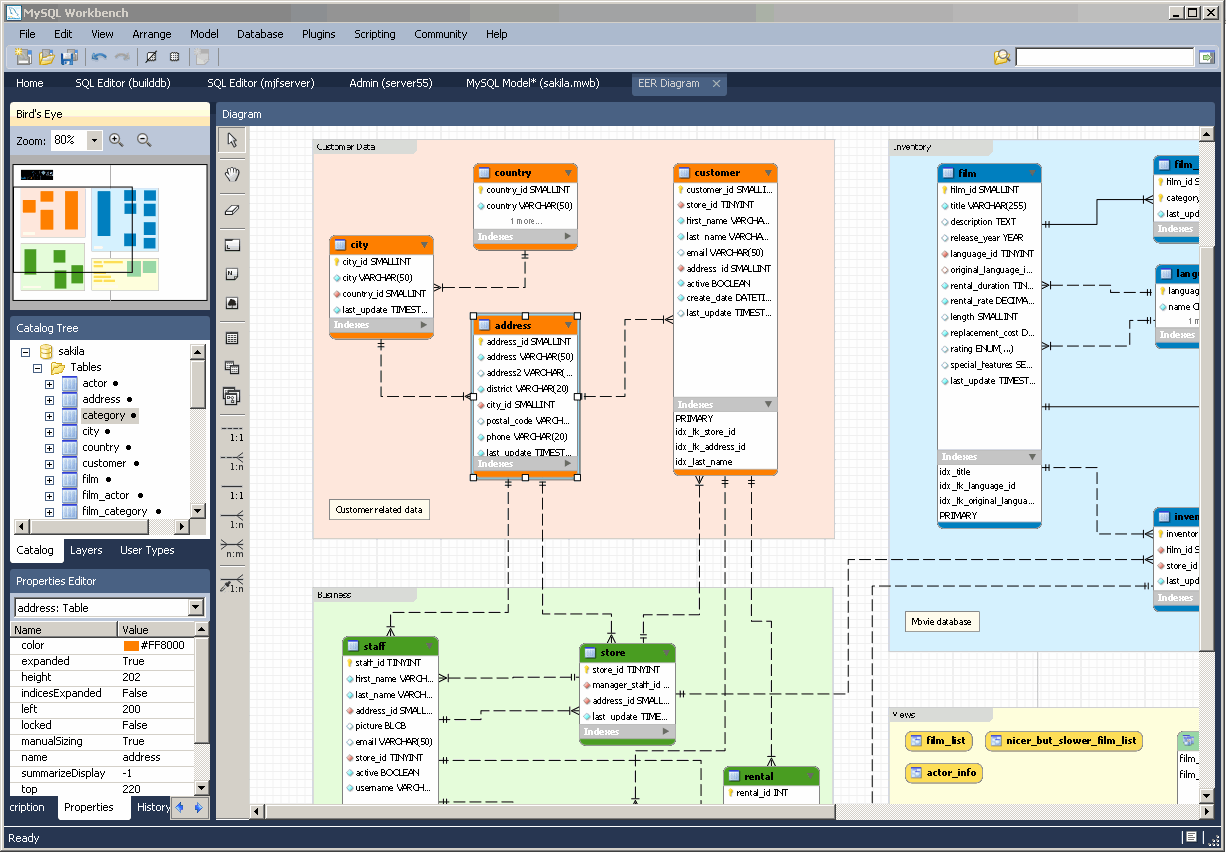
MySQL is the most popular Open Source Relational SQL database management system. 
MySQL is one of the best RDBMS being used for developing web-based software applications.
This tutorial will give you quick start with MySQL and make you comfortable with MySQL programming.

Audience

This reference has been prepared for the beginners to help them understand the basics to advanced concepts related to MySQL languages.

Prerequisites

Before you start doing practice with various types of examples given in this reference, I'm making an assumption that you are already aware about what is database, especially RDBMS and what is a computer programming language.

Compile/Execute MySQL Programs

If you are willing to compile and execute SQL programs with SQLite DBMS but you do not have a set up for the same, then do not worry. The compileonline.com is available on a high end dedciated server giving you real programming experience with a comfort of single click execution. Yes! it is absolutely free and it's online
prepared by:
Maira Alejandra Palacios Córdoba

INPUT N°4 GRUOP C FILE: 891434

CASE Tools

CASE tools are set of software application programs, which are used to automate SDLC activities. CASE tools are used by software project managers, analysts and engineers to develop software system.
There are number of CASE tools available to simplify various stages of Software Development Life Cycle such as Analysis tools, Design tools, Project management tools, Database Management tools, Documentation tools are to name a few.
Use of CASE tools accelerates the development of project to produce desired result and helps to uncover flaws before moving ahead with next stage in software development.


Prepared by: 
Sebastian Salas Mejía


Grupo A Entrada 1 Ficha 812420-812409


Elizabeth Pérez Alfonso

ALGORITHM


An algorithm is a set of instructions designed to perform a specific task. This can be a simple process, such as multiplying two numbers, or a complex operation, such as playing a compressed video file.

A computer program can be viewed as an elaborate algorithm. In mathematics and computer science, an algorithm usually means a small procedure that solves a recurrent problem.


In computer programming, algorithms are often created as functions. These functions serve as small programs that can be referenced by a larger program. For example, an image viewing application may include a library of functions that each use a custom algorithm to render different image file formats.


Norberto Cárdenas Luna

DATABASE


A database is an organized collection of data.[1] The data is typically organized to model aspects of reality in a way that supports processes requiring information. For example, modelling the availability of rooms in hotels in a way that supports finding a hotel with vacancies.


Database management systems are computer software applications that interact with the user, other applications, and the database itself to capture and analyze data. A general-purpose DBMS is designed to allow the definition, creation, querying, update, and administration of databases. Well-known DBMSs include MySQL, PostgreSQL, Microsoft SQL Server, Oracle, Sybase and IBM DB2. A database is not generally portable across different DBMSs, but different DBMS can interoperate by using standards such as SQL and ODBC or JDBC to allow a single application to work with more than one DBMS. Database management systems are often classified according to the database model that they support; the most popular database systems since the 1980s have all supported the relational model as represented by the SQL language. Sometimes a DBMS is loosely referred to as a 'database'.


Jhon Alexander Muñoz

DATA

Is a set of values of qualitative or quantitative variables; restated, pieces of data are individual pieces of information. Data is measured, collected and reported, and analyzed, whereupon it can be visualized using graphs or images. Data as an general concept refers to the fact that some existing information or knowledge is represented or coded in some form suitable for better usage or processing.


Raw data, i.e., unprocessed data, refers to a collection of numbers, characters and is a relative term; data processing commonly occurs by stages, and the "processed data" from one stage may be considered the "raw data" of the next. Field data refers to raw data that is collected in an uncontrolled in situ environment. Experimental data refers to data that is generated within the context of a scientific investigation by observation and recording.




INPUT N° 3 GRUOP C FILE: 891434

Firewall

A firewall is a device that works as a firewall between networks, allowing or denying the transmissions from one network to another. A typical use is to place it between the local network and the Internet, as a safety device to prevent intruders from accessing your sensitive information. A firewall is simply a filter that controls all communications that are passed on from one network to another and depending on what you are allowed or denied your step.


In this way a firewall can allow from a local network to the Internet web services, mail and ftp, but not to the IRC that can be unnecessary for our work. We can also set the accesses that are made from the Internet to the local network and we can deny all or allow some services such as the web, (if it is that we have a web server and want accessible from the Internet).

A firewall can be a software or hardware device, i.e. a gizmo that connects between the network and the cable of the Internet connection, or a program that is installed on the machine that has the modem that connects to the Internet. We can even find computers very powerful computers and with specific software that the only thing they do is monitor the communications between networks.


prepared by:
Laura Marcela Ramírez Laverde 

INPUT N° 2 GROUP C FILE: 891434

DDL (Data Definition Lenguaje )

Simple artificial lenguaje, serves to define and describe the objects in the database, structure, relations and constraints. Some examples of functions: creation, modification and deletion of tables that make up the database.


Resultado de imagen para ddl


1. Create table: is used to create new tables in the database
Example:
 
CREATE TABLE Persons

(

PersonID int,

LastName varchar (255),

FirstName varchar(255),

Address varchar(255),

City varchar(255)

);

2. Drop table: is used to delete tables in the database
Example:

DROP TABLE Persons

3. Alter table: is used to modify the tables of the database, adding fields or changing the definition of fields
Example:

ALTER TABLE Persons

ADD column_name datatype

Prepared by:
María Paula Herrera López
 

INPUT N°1 GOUP C FILE : 891434

COUNTER:

A counter is a variable whose  value is incremented or decremented in a constant quantity each occasion time a particular event or action occurs. Counters are used in order to count events or internal actions of a bluce; must perform an operation initialization and then successive increment or decrement the same. 
STRUCTURE: int cont = 0 initiation of the bluce cont = cont +1 end of the bluce  
                         
Prepared by: 
Andres Felipe Leon Villa

Grupo D:Ficha 891434

                                                            Analyst

The systems analyst is a professional in the area of IT, applications development manager in terms of its design and production of algorithms and analyze the possible uses and modifications of the operating systems for greater efficiency of a computer system. Another mission of these people is to give technical support to users of existing applications.